

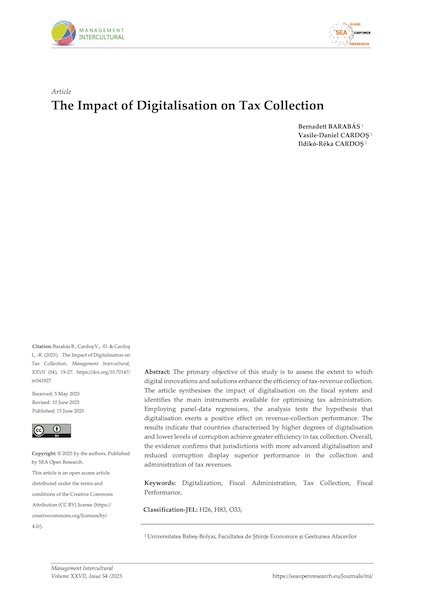
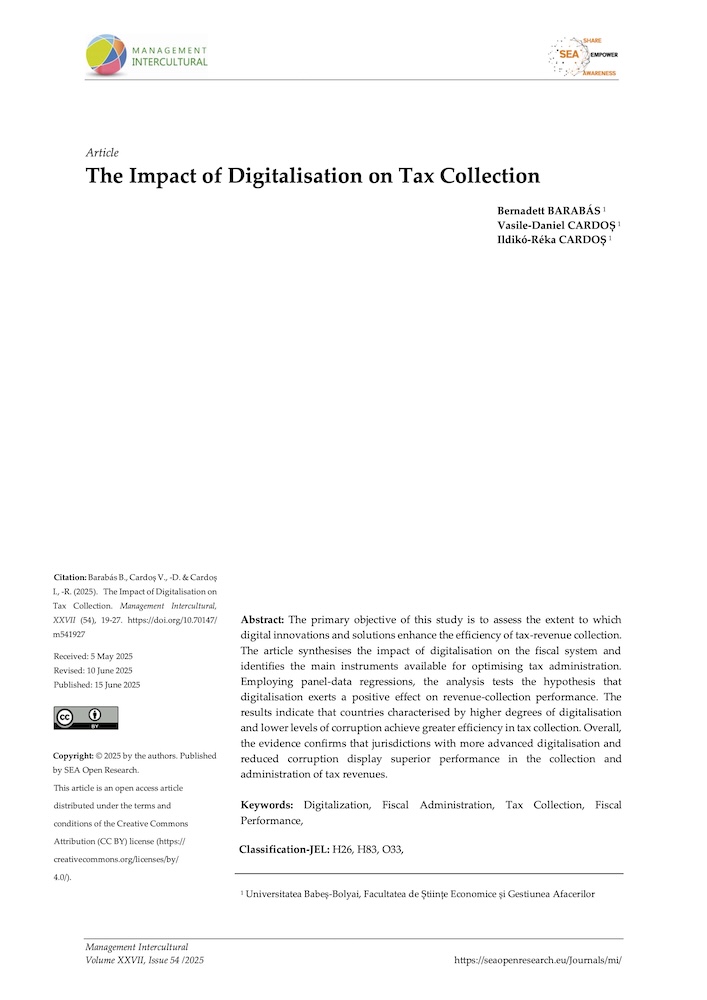
The primary objective of this study is to assess the extent to which digital innovations and solutions enhance the efficiency of tax-revenue collection. The article synthesises the impact of digitalisation on the fiscal system and identifies the main instruments available for optimising tax administration. Employing panel-data regressions, the analysis tests the hypothesis that digitalisation exerts a positive effect on revenue-collection performance. The results indicate that countries characterised by higher degrees of digitalisation and lower levels of corruption achieve greater efficiency in tax collection. Overall, the evidence confirms that jurisdictions with more advanced digitalisation and reduced corruption display superior performance in the collection and administration of tax revenues.
- Citation: Barabás B., Cardoș V., -D. & Cardoș I., -R. (2025). The Impact of Digitalisation on Tax Collection. Management Intercultural, XXVII (54),19-27. https://doi.org/10.70147/m541927
- Published on: 15th June 2025
- Keywords: Digitalization, Fiscal Administration, Tax Collection, Fiscal Performance,
- Pages: 19-27
- Received: 5th May 2025
- Final revision and acceptance: 10th June 2025
- Download: PDF
- Doi: https://doi.org/10.70147/m541927