

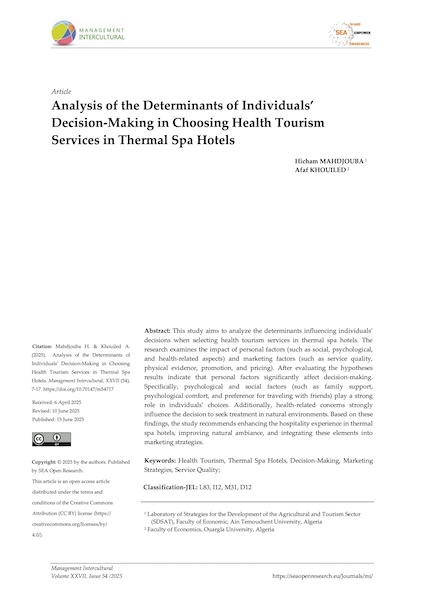
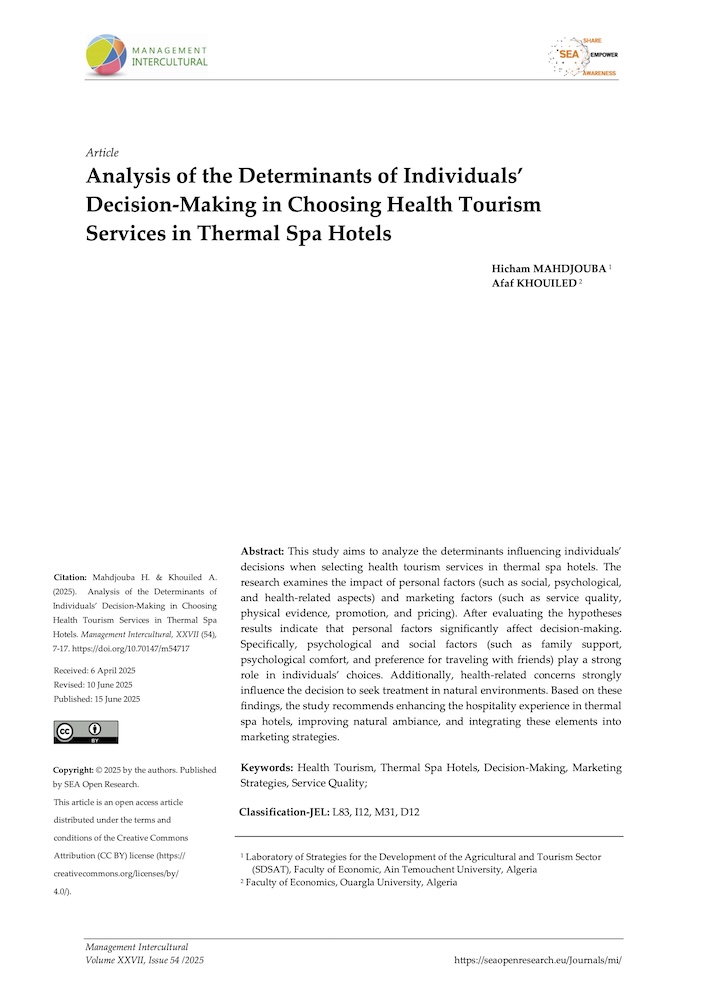
This study aims to analyze the determinants influencing individuals’ decisions when selecting health tourism services in thermal spa hotels. The research examines the impact of personal factors (such as social, psychological, and health-related aspects) and marketing factors (such as service quality, physical evidence, promotion, and pricing). After evaluating the hypotheses results indicate that personal factors significantly affect decision-making. Specifically, psychological and social factors (such as family support, psychological comfort, and preference for traveling with friends) play a strong role in individuals’ choices. Additionally, health-related concerns strongly influence the decision to seek treatment in natural environments. Based on these findings, the study recommends enhancing the hospitality experience in thermal spa hotels, improving natural ambiance, and integrating these elements into marketing strategies.
- Citation: Mahdjouba H. & Khouiled A. (2025). Analysis of the Determinants of Individuals’ Decision-Making in Choosing Health Tourism Services in Thermal Spa Hotels. Management Intercultural, XXVII (54), 7-17. https://doi.org/10.70147/m54717
- Published on: 15th June 2025
- Keywords: Health Tourism, Thermal Spa Hotels, Decision-Making, Marketing Strategies, Service Quality,
- Pages: 7-17
- Received: 6th April 2025
- Final revision and acceptance: 10th June 2025
- Download: PDF
- Doi: https://doi.org/10.70147/m54717
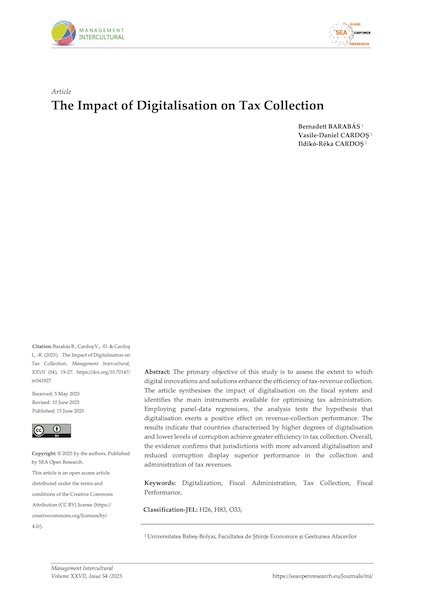
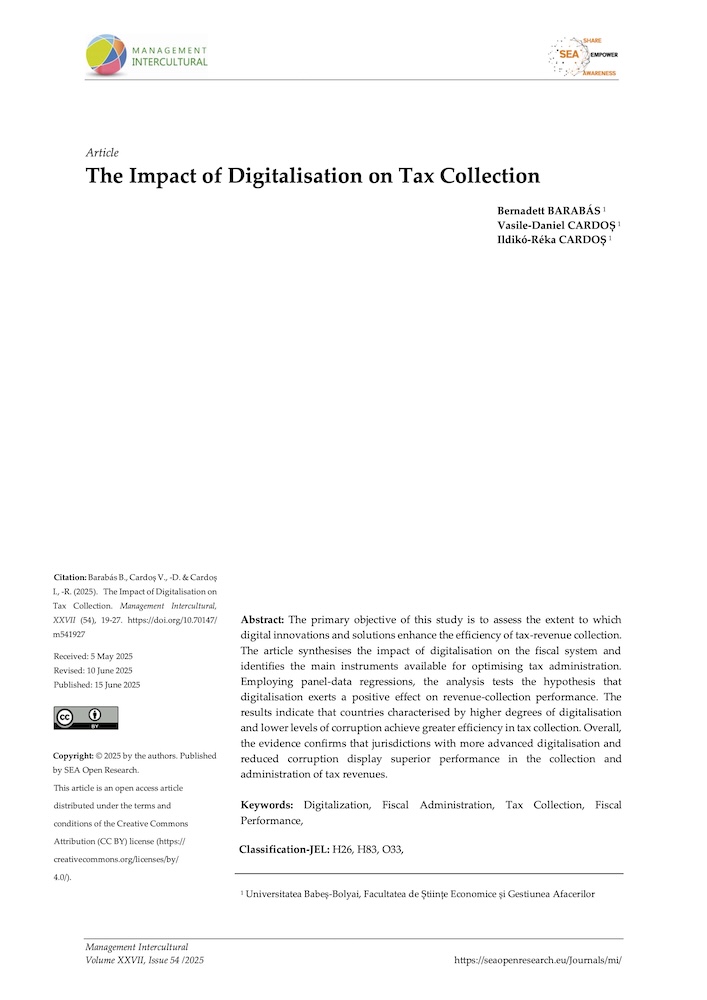
The primary objective of this study is to assess the extent to which digital innovations and solutions enhance the efficiency of tax-revenue collection. The article synthesises the impact of digitalisation on the fiscal system and identifies the main instruments available for optimising tax administration. Employing panel-data regressions, the analysis tests the hypothesis that digitalisation exerts a positive effect on revenue-collection performance. The results indicate that countries characterised by higher degrees of digitalisation and lower levels of corruption achieve greater efficiency in tax collection. Overall, the evidence confirms that jurisdictions with more advanced digitalisation and reduced corruption display superior performance in the collection and administration of tax revenues.
- Citation: Barabás B., Cardoș V., -D. & Cardoș I., -R. (2025). The Impact of Digitalisation on Tax Collection. Management Intercultural, XXVII (54),19-27. https://doi.org/10.70147/m541927
- Published on: 15th June 2025
- Keywords: Digitalization, Fiscal Administration, Tax Collection, Fiscal Performance,
- Pages: 19-27
- Received: 5th May 2025
- Final revision and acceptance: 10th June 2025
- Download: PDF
- Doi: https://doi.org/10.70147/m541927
This article aims to highlight the efforts made in Algeria to launch digital banking and attempts to evaluate the impact of the development of digital banking on the performance of the Algerian banking sector after the establishment of two payment systems modern ARTS and ATCI using multiple linear regression for the period from 2010 to 2023. The results show that the activity of the ARTS which concerns transfers of trustees by tele -compensation is the source of banking profitability while digital banking services processed by the ATCI d’ont contribute to improving the performance and profitability of the Algerian banking sector.
- Citation: Taleb, A. F., Slimani, Z. & Bennouna, S., M. (2025). Impact of digitalization on the performance of the Algerian banking sector. Management Intercultural, XXVII (54), 29-39. https://doi.org/10.70147/m542939
- Published on: 15th June 2025
- Keywords: Digitalization, Online Banking, Gross Domestic Product, Performance of the Banking Sector,
- Pages: 29-39
- Received: 13th April 2025
- Final revision and acceptance: 10th June 2025
- Download: PDF
- Doi: https://doi.org/10.70147/m542939
This article explores the impact of digitalization on the accounting profession, with a focus on the use and effectiveness of ERP (Enterprise Resource Planning) systems. The theoretical part emphasizes the growing role of technology in transforming traditional accounting through automation and digitalization. Despite challenges such as limited digital skills and resistance to change, digitalization is seen as crucial for professional development. Based on a survey of 218 Romanian accounting professionals, the study finds high familiarity with ERP systems and a generally positive perception of their benefits, including faster access to financial data, process automation, and fewer errors. However, issues such as insufficient training and technical difficulties persist. Overall, respondents view ERP systems as essential for decision-making and regulatory compliance. The study concludes that continuous investment in training, technical support, and system updates is vital for successful ERP integration in accounting.
- Citation: Cardoș, V.-D., Cardoș, I.-R., & Stan, I. (2025). Advantages of ERP system implementation from the perspective of Romanian accounting professionals. Management Intercultural, XXVII (54), 41-50. https://doi.org/10.70147/m544150
- Published on: 15th June 2025
- Keywords: Digitalization, ERP Systems, Accounting Profession, Challenges,
- Pages: 41-50
- Received: 7th May 2025
- Final revision and acceptance: 10th June 2025
- Download: PDF
- Doi: https://doi.org/10.70147/m544150


This article carries out a systematic analysis of the way in which primary emotions were described and understood in Antiquity, starting from East to West. From the Japanese space to the Egyptian and Greek territory, across the Asian, European and African continents, following the paths of the most valuable road of those times - the Silk Road -, the article proposes a brief review of the way in which the six primary emotions identified by Paul Ekman were experienced: joy, sadness, anger, fear, disgust and surprise. Making an incursion into the history of psychology, namely the way in which the main religions and historical events influenced emotional experiences in Antiquity, the article attempts to demonstrate that certain primary emotions were not universal: emotions are understood and experienced differently, from one culture to another, from one religion to another, from one time to another.
- Citation: Botone, D., (2025). Psychology of Emotions in Antiquity. From East to West, for Understanding Emotions. Management Intercultural, XXVII (54), 51-57. https://doi.org/10.70147/m545157
- Published on: 30 June 2025
- Keywords: Emotions, Aristotel, Platon, Confucius, Rumi, Feelings, Antiquity, Psychology,
- Pages: 51-57
- Received: 10 May 2025
- Final revision and acceptance: 12 June 2025
- Download: PDF
- Doi: https://doi.org/10.70147/m545157